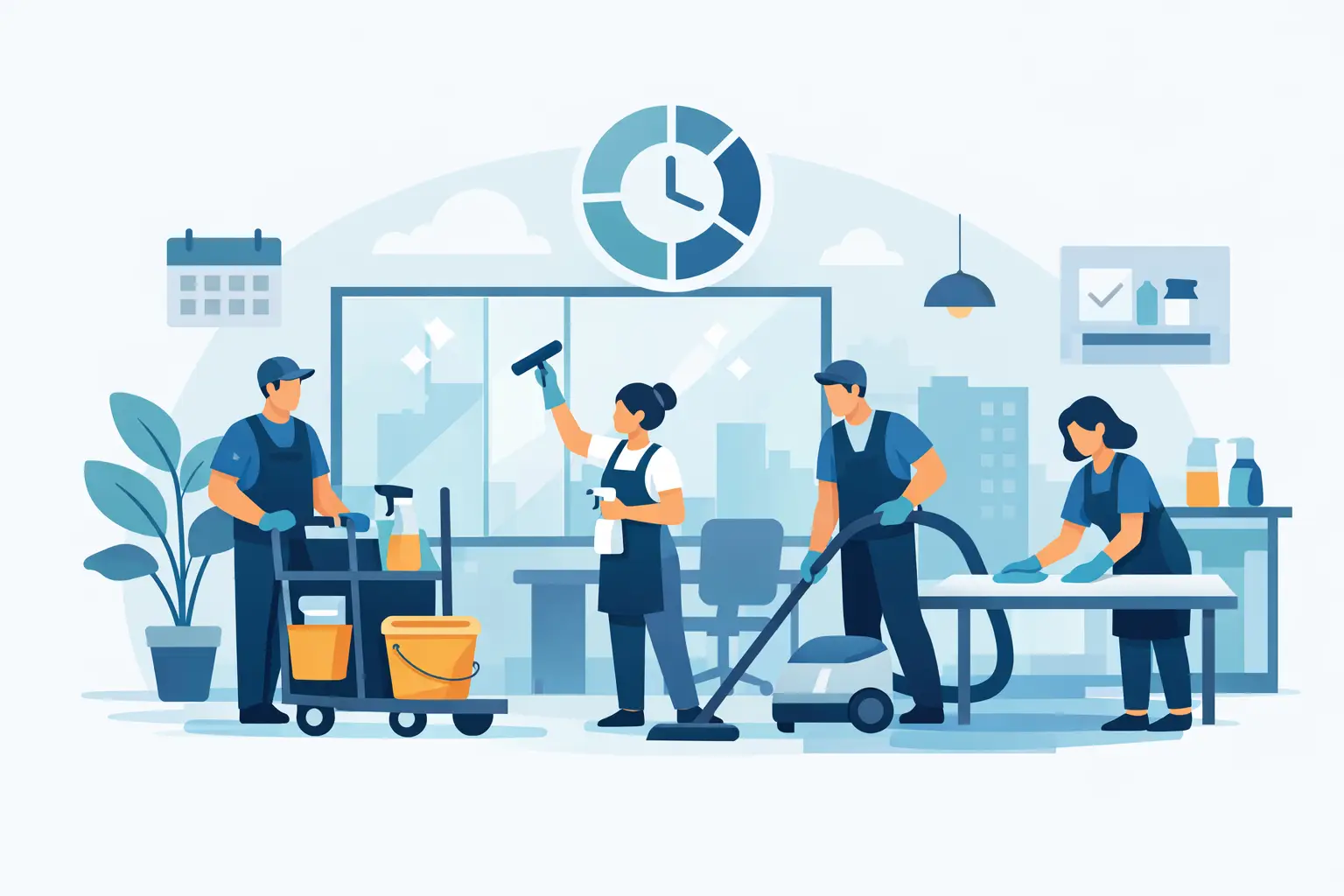
Miss a week of washroom checks or leave entrance floors too long between cleans, and people notice fast. A good commercial cleaning frequency guide helps you set the right schedule before standards slip, complaints build up, or a one-off deep clean becomes an expensive catch-up job.
There is no single timetable that fits every site. A serviced office with light footfall does not need the same routine as a restaurant kitchen, a busy retail unit, or a short-let property with constant guest turnover. The right frequency depends on how the space is used, how many people move through it, what regulators expect, and how much risk you can afford to carry between visits.
How to use a commercial cleaning frequency guide
Think of frequency as a control tool, not a guess. The aim is to keep standards steady with the least disruption to your team, customers, guests, or tenants. That usually means separating visible cleaning from hygiene-critical cleaning and then matching both to real traffic patterns.
Start with four practical questions. How many people use the space each day? Which areas create the strongest first impression? Which surfaces are touched constantly? And where would poor cleaning create the biggest operational problem? In some buildings, that is the reception and toilets. In others, it is food prep zones, lift buttons, bins, or communal kitchens.
It also helps to track what happens when cleaning is left too long. If floors lose appearance after two days, that is your answer. If washrooms stay acceptable with one full clean plus daytime checks, that may be enough. Frequency works best when it reflects evidence, not habit.
Recommended commercial cleaning frequency by area
Most commercial sites need a layered schedule. Some tasks are daily because appearance and hygiene drop quickly. Others can sit on a weekly or monthly cycle without causing issues. The trick is knowing which is which.
Entrances, reception areas and high-traffic floors
These areas usually need attention every day, and sometimes more than once a day. Entrance glass, door handles, hard floors, mats, and lift lobbies collect dirt quickly, especially in wet weather. If customers or visitors form their first impression here, daily cleaning is the safe baseline.
In busier buildings, spot cleaning during the day is often more useful than adding a heavier clean later. Mud, litter, fingerprints, and tracked-in debris are visible immediately. Waiting until evening can make the whole site look unmanaged.
Toilets and washrooms
Washrooms should be cleaned daily at a minimum in almost all commercial settings. In offices with moderate use, one full clean per day plus consumable checks may be enough. In retail, hospitality, healthcare-adjacent settings, or shared buildings, multiple checks and refreshes across the day are usually necessary.
This is one area where under-cleaning has a fast cost. Complaints rise quickly, staff confidence drops, and poor supply management creates avoidable friction. A toilet that is technically cleaned each evening but runs out of soap by lunchtime is not on an effective schedule.
Desks, meeting rooms and shared office spaces
General office cleaning is often set on a daily weekday schedule, with weekends depending on occupancy. Desks, bins, kitchenettes, floors, and touchpoints usually need routine attention to keep the space usable. Meeting rooms may need same-day resets if they are booked back-to-back.
The trade-off is cost versus presentation. If your team works hybrid patterns and the office is quiet on certain days, you may be able to reduce frequency in low-use zones. But shared touchpoints such as door plates, kettles, fridge handles, and breakout tables can still need daily attention.
Kitchens and break areas
Commercial staff kitchens need daily cleaning, particularly sinks, worktops, appliance exteriors, and bins. If food is prepared on site or usage is heavy, mid-day checks are sensible. Fridges, microwaves, and cupboard fronts often fall into the category of jobs that look fine until they suddenly do not.
A weekly deeper clean usually works well here alongside daily maintenance. That gives enough frequency for grease, spills, and odour control without overloading the daily schedule.
Retail floors and customer-facing spaces
Retail cleaning frequency depends heavily on footfall. For many shops, daily cleaning is the minimum for floors, tills, fitting rooms, entrances, and washrooms. In high-footfall locations, daytime touch-ups matter just as much as the main clean.
Displays and shelving may not need full daily treatment, but visible dust and smudges quickly affect how customers read the space. If your trading hours are long, an early-morning or after-close clean is usually the most practical setup.
Restaurants, cafés and food service sites
Food service businesses work on a much tighter cycle. Front-of-house floors, toilets, touchpoints, counters, and bins need daily cleaning, often with repeated checks during service. Back-of-house and kitchen cleaning usually follows a mix of per-shift, daily, weekly, and periodic deep-clean requirements.
This is where a generic office-style schedule fails. Grease, waste, spills, and food safety standards change the equation. The right frequency is driven as much by compliance and hazard control as by appearance.
Short-let, Airbnb and rental turnover cleaning
Turnover properties do not follow a neat daily or weekly pattern. Their cleaning frequency is tied to each checkout, with periodic deeper work layered on top. If bookings are dense, that can mean several full cleans per week. If the property is empty for a stretch, a pre-arrival refresh may still be needed.
Linen, bathrooms, kitchens, floors, and touchpoints need full reset standards every time. Monthly deep tasks such as limescale treatment, upholstery care, or appliance detailing help prevent wear from showing between guest stays.
Daily, weekly and monthly cleaning tasks
A useful commercial cleaning frequency guide is built around intervals. Daily tasks usually include floors, bins, toilets, visible surfaces, and touchpoints. Weekly tasks often cover skirting, internal glass, lower-level detailing, fridge interiors, and a closer clean of shared areas.
Monthly or periodic tasks are where standards are protected long term. Carpet treatment, high dusting, machine scrubbing, deep kitchen work, and full washroom descaling do not need to happen every day, but leaving them too long shortens the life of the space. If your site always feels clean enough but never truly clean, the monthly layer is probably missing.
Season also matters. Rainy months increase entrance cleaning needs. Summer can raise odour and pest risks around waste areas. Winter often puts more pressure on lobbies, mats, and communal areas because dirt is tracked in more heavily.
Signs your current cleaning frequency is wrong
If your team is reporting issues before the next scheduled clean, the gap is too long. The same applies if bins overflow regularly, washrooms lose supplies early, or reception floors look worn halfway through the day. Cleaning frequency should prevent these problems, not simply respond to them.
There is also such a thing as over-scheduling. If cleaners arrive when the site is barely used, repeat tasks that are already in good order, or cause avoidable disruption, you may be paying for frequency you do not need. A better setup is often a targeted plan with more checks in critical zones and less effort in low-impact areas.
Building a schedule that matches your site
The best schedule is specific. A small office, a multi-tenant building, a restaurant and a managed rental portfolio should not share the same template. Start by dividing the site into high-risk, high-visibility, and low-use areas. Then assign cleaning frequency according to consequence, not convenience.
It is also worth deciding what must happen out of hours and what can happen during the day. Early-morning or evening cleans suit most routine work, but daytime support can be the difference between a tidy site and a visibly declining one. This is especially true for washrooms, retail floors, and hospitality settings.
If you manage several properties or sites, consistency matters as much as frequency. A booking-based service model can help you keep recurring schedules, specialist cleans, and ad hoc jobs under one system rather than chasing different suppliers for different tasks. That is often where time is lost.
For London businesses, landlords and property managers dealing with mixed-use spaces, turnovers, and varying occupancy, flexibility matters just as much as standards. The right plan is one you can actually maintain. Set the baseline, review it after a few weeks, and adjust before small cleaning issues become operational ones.
A clean space should not depend on luck or last-minute fixes. When the schedule fits the building, everything runs more smoothly - for staff, customers, guests, and anyone responsible for the property.