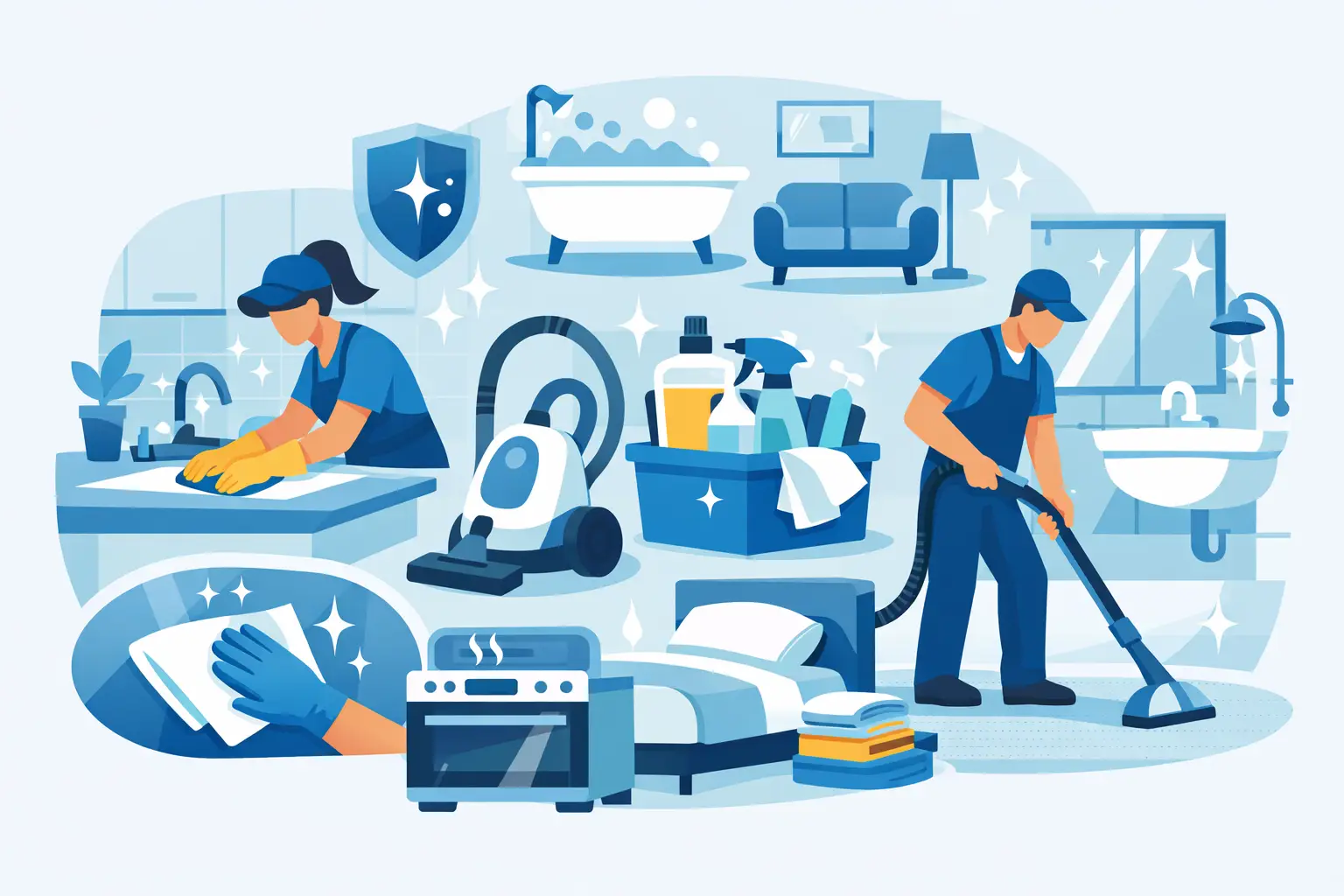
A quick wipe of the worktops and a pass with the hoover will keep a home ticking over, but that is not what people mean when they ask what a deep cleaning service includes. Deep cleaning is the job you book when standard cleaning is no longer enough - after months of build-up, before guests arrive, ahead of a tenancy handover, or when you want the whole property brought back under control.
The detail matters because deep cleaning is often assumed to mean "everything". In practice, it is much more precise than that. A proper deep clean is a more intensive version of domestic cleaning, focused on built-up grime, neglected surfaces and harder-to-reach areas. It goes beyond presentation and deals with hygiene, residue and dirt that routine visits usually do not cover.
What deep cleaning service includes in most homes
In most properties, a deep clean covers all the main rooms, but with more time spent on each task and more attention paid to problem areas. That usually means kitchens, bathrooms, bedrooms, living spaces, hallways and stairs all receive a full top-to-bottom clean.
Surfaces are dusted and wiped thoroughly rather than quickly refreshed. Floors are vacuumed and mopped with care around edges and corners. Skirting boards, door frames, switches, handles and visible marks on painted surfaces are typically cleaned where possible. Internal glass, mirrors and reachable ledges are usually included as standard.
The big difference is build-up. Standard cleaning keeps on top of a space. Deep cleaning tackles what has already accumulated. Think grease on kitchen cupboard fronts, limescale around taps, soap residue in shower screens, dust behind furniture that can be moved safely, and grime around high-touch points.
That does not always mean every single item in the property is moved, dismantled or treated with specialist products. It depends on access, time booked, the condition of the home and whether additional services have been selected.
Kitchen deep cleaning usually goes further
The kitchen is often the room where the difference is most obvious. A deep clean normally includes degreasing worktops, splashbacks, cupboard exteriors, appliance fronts, tiles and sinks. The hob gets more attention than it would on a standard clean, with built-up grease, burnt-on residue and marks treated properly rather than wiped over.
Cupboard doors, drawer fronts and handles are generally cleaned in detail because they collect fingerprints, cooking film and dust. The sink area is descaled and polished where suitable. Floors are cleaned carefully, especially along kickboards and under accessible edges where crumbs and grease settle.
Some kitchen tasks are often treated as optional extras rather than automatic inclusions. Inside the oven, inside the fridge, inside cupboards and behind large appliances may require separate booking or extra time. That is not a sign of a poor service. It is simply because these jobs can add a lot of labour and, in some cases, need specialist materials or separate pricing.
If you are booking for a move, a post-tenancy clean or after a long period without maintenance, it is worth checking those details in advance. Customers often assume appliance interiors are part of every deep clean, but they are not always included by default.
Bathrooms are cleaned for hygiene as well as appearance
Bathrooms respond well to deep cleaning because residue tends to build slowly and then suddenly looks impossible to shift. A deep clean usually includes descaling taps, shower fittings, tiles, screens, baths, sinks and toilets. Soap scum, watermarks and product build-up are treated much more thoroughly than during a regular visit.
Attention is usually given to grout lines, sealant edges, toilet bases and hard-to-reach corners where dirt gathers. Mirrors are polished, fittings are wiped, and floors are cleaned with extra focus around the edges and behind the toilet where routine cleaning can miss spots.
That said, there is a limit to what cleaning alone can achieve. Stained grout, blackened sealant, long-term mould damage or etched glass may improve but not return to a like-new finish. This is one of the most important trade-offs to understand. Deep cleaning removes dirt and residue. It does not reverse wear, deterioration or damage caused over time.
Bedrooms and living areas get more detailed attention
In bedrooms and shared living spaces, the goal is to clear the dust, marks and overlooked dirt that gradually settle into daily life. This usually includes dusting skirting boards, accessible light fittings, furniture exteriors, shelves, bedside units, tables, wardrobes on the outside, and decorative surfaces that do not get touched often during standard cleaning.
Floors are vacuumed thoroughly, including edges, under beds where access allows, and around furniture that can be moved safely. Hard floors are mopped with attention to corners and traffic marks. Mirrors and internal windows are cleaned, and visible fingerprints or smudges on doors, handles and switches are removed.
Soft furnishings can vary. A cleaner may vacuum sofas or upholstered chairs externally, but stain removal or deep upholstery treatment is usually a separate specialist service. The same goes for carpets. Vacuuming is commonly included, but machine carpet cleaning is not usually part of a general deep clean unless specifically booked.
What is often excluded from a deep clean
This is where expectations need to be clear. Even when a provider offers an intensive service, some tasks sit outside the usual scope. External window cleaning, carpet shampooing, upholstery cleaning, full mould remediation, pest-related cleaning, biohazard work and waste removal are commonly excluded unless arranged separately.
Heavy lifting is another grey area. Cleaners will often work around furniture or move lighter items safely, but they are unlikely to shift wardrobes, white goods or anything that risks injury or damage. Likewise, high-level cleaning above safe reach may not be included unless the property is suitable and access equipment is available.
There can also be sensible limits around personal belongings. If surfaces are covered with clothes, paperwork, toys or general clutter, cleaning can only go so far. Tidying and decluttering are not always part of the booking unless discussed beforehand.
When a deep clean makes most sense
A deep clean is not something every property needs every week. It makes more sense at transition points or when standards have slipped beyond what a normal visit can recover. Before starting a regular cleaning schedule is a common example. It gives the home a proper reset, so future visits are maintaining a good level rather than chasing old build-up.
It is also useful before or after a tenancy, ahead of hosting guests, after renovation dust, after illness in the household, or when a property has been empty for a while. Landlords and property managers often use deep cleaning to bring a flat back to a lettable condition quickly. Busy households book it when life has outrun the weekly routine.
For short-let hosts and hospitality operators, deep cleaning can also work as a periodic reset between standard turnover cleans. It helps preserve presentation and hygiene in spaces that see constant use.
How to check what your booking includes
The safest approach is to look at the service description line by line before you book. A reliable platform should make the scope easy to understand, not buried in vague promises. If you need inside appliances, interior cupboards, balcony cleaning or a focus on a particular area, check that those tasks are listed or available as add-ons.
It also helps to be honest about the property condition. A lightly used one-bed flat and a heavily soiled family kitchen do not require the same amount of time. Underbooking is one of the main reasons customers feel disappointed. The cleaner may do a good job, but if the property needs six hours and only three were booked, something will be left out.
This is where an organised booking system matters. With a platform-led service such as Letusclean4u, customers can choose the right category, manage the booking clearly and avoid the back-and-forth that often slows things down.
Deep cleaning service includes more than extra time
The best way to think about it is this: deep cleaning service includes a higher level of detail, more focus on neglected areas and a more realistic attempt to remove built-up dirt throughout the home. It is not magic, and it is not always identical from one provider to another, but it should feel noticeably more thorough than a standard clean.
If you are comparing services, do not just ask for the price. Ask what is covered, what is optional, how long is allowed, and whether your property needs any specialist extras. The right booking is the one that matches the condition of the space, not the one with the shortest checklist.
A well-timed deep clean gives you something simple but valuable - a property that feels properly reset, easier to maintain, and much less stressful to live or work in.